AmblesideOnline's Annotated Charlotte Mason Series
It is with pleasure that this online version of Charlotte Mason's six-volume book series is provided for public reading and study. Her own words (below) lead one to believe that she would have wanted the truths she discovered to be shared freely with the public, and it is hoped that her words will inspire all who teach to use her ideas 'for the children's sake.' (This edition of the Charlotte Mason Series, typed by AmblesideOnline volunteers, is copyrighted to AmblesideOnline, and may not be published or re-posted elsewhere. Please refer to our License for more information.)
Volume 1 - Home Education
Volume 2 - Parents and Children
Volume 3 - School Education
Volume 4 - Ourselves
Volume 5 - Formation of Character
Volume 6 - Towards A Philosophy of Education
Not sure which volume to start with? Click here for help.
NEW: The Series Arranged Topically (In progress; available only for the Modern English paraphrases)
Charlotte Mason's Homeschool Series in Modern English - a sentence-by-sentence paraphrase of each of Charlotte Mason's six books. Read online, or purchase in paperback.
Summaries of all six volumes - The Reader's Digest version, condensed paragraph by paragraph; perfect to get an overview if you're just starting out.
Summary of CM's 20 Principles - a concise version of the definitives of a CM Education
Summary of CM's Student's motto, "I am, I can, I ought, I will."
In Memoriam - a tribute written by students, co-workers and friends of Charlotte
Mason on the event of her death in 1923. This book provides a concise synopsis of her methods as well as personal remembrances and insight into her personality.
The Saviour of the World, six volumes of poems by Charlotte Mason based on the New Testament
Purchase individual copies of vol 1 (£amzn), vol 2 (£amzn), vol 3 (£amzn), vol 4 (£amzn), vol 5 (£amzn), vol 6 (£amzn)
Or purchase all six volumes as a Bundle Set in various formats directly from Living Books Press (£)
View a scan of a page of the CM Series.
How to Download to Your Kindle for Free
A list of subjects, and where in the series they're discussed, compiled by Melissa Newman
AO is a participant in the Amazon Services LLC Associates Program, an affiliate advertising program designed to provide a means for sites to earn advertising fees by advertising and linking to amazon.com.
AO is an affiliate of Living Book Press, which means that when you purchase from livingbookpress.com we receive a commission which allows us to keep offering AO for free.
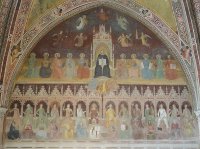
The fresco at the Spanish chapel at Santa Maria Novella, Florence (John Ruskin called this fresco the 'Vaulted Book') is pictured online. Charlotte Mason discusses the top and bottom of one wall in various volumes. The fresco is attributed to Andrea di Bonaiuto da Firenze, a painter of the 1300's, but in CM's day, it was thought to have been done by Taddeo Gaddi and Simone Memmi. Charlotte Mason loved the way it illustrated her concept of the Holy Spirit gifting men with knowledge, even "secular" knowledge.
Six lectures by Charlotte Mason's about the raising and educating of young children (up to age 9) written for parents and teachers. Download free epub file that will work on Kindle. Purchase a copy of volume 1 (£amzn) Or purchase all six volumes as a Bundle Set directly from Living Books Press (£)
Preface
Part 1 Some Preliminary Considerations . . . pg. 1
I. A Method Of Education . . . pg. 6
II. The Child's Estate . . . pg. 11
III. Offending The Children . . . pg. 13
IV. Despising The Children . . . pg. 17
V. Hindering The Children . . . pg. 19
VI. Conditions Of Healthy Brain-Activity . . . pg. 20
VII. 'The Reign Of Law' In Education . . . pg. 37
Part II Out-Of-Door Life For The Children
(first portion)
I. A Growing Time . . . pg. 42
II. Sight-Seeing . . . pg. 45
III. Picture-Painting . . . pg. 48
IV. Flowers And Trees . . . pg. 51
V. 'Living Creatures' . . . pg. 56
VI. Field-Lore And Naturalists' Books . . . pg. 62
VII. The Child Gets Knowledge By Means Of His Senses . . . pg. 65
VIII. The Child Should Be Made Familiar With Natural Objects . . . pg. 69
(second portion)
IX. Out-Of-Door Geography . . . pg. 72
X. The Child And Mother-Nature . . . pg. 78
XI. Out-Of-Door Games, Etc. . . . pg. 80
XII. Walks In Bad Weather . . . pg. 85
XIII. 'Red Indian' Life . . . pg. 88
XIV. The Children Require Country Air . . . pg. 92
Part III 'Habit Is Ten Natures'
I. Education Based Upon Natural Law . . . pg. 96
II. The Children Have No Self-Compelling Power . . . pg. 98
III. What Is 'Nature'? . . . pg. 100
IV. Habit May Supplant 'Nature' . . . pg. 105
V. The Laying Down Of Lines Of Habit . . . pg. 107
VI. The Physiology Of Habit . . . pg. 111
VII. The Forming Of A Habit -- 'Shut The Door After You' . . . pg. 119
VIII. Infant 'Habits' . . . pg. 124
IX. Physical Exercises . . . pg. 132
Part IV Some Habits Of Mind - Some Moral Habits . . . pg. 135
I. The Habit Of Attention . . . pg. 137
II. The Habits Of Application, Etc. . . . pg. 149
III. The Habit Of Thinking . . . pg. 150
IV. The Habit Of Imagining . . . pg. 151
V. The Habit Of Remembering . . . pg. 154
VI. The Habit Of Perfect Execution . . . pg. 159
VII. Some Moral Habits -- Obedience . . . pg. 160
VIII. Truthfulness, Etc. . . . pg. 164
Part V Lessons As Instruments Of Education
(first portion)
I. The Matter And Method Of Lessons . . . pg. 169
II. The Kindergarten As A Place Of Education . . . pg. 178
III. Further Consideration Of The Kindergarten . . . pg. 182
(second portion)
IV. Reading . . . pg. 199
V. The First Reading Lesson . . . pg. 207
VI. Reading By Sight And Sound . . . pg. 214
VIII. Recitation . . . pg. 222
VIII. Reading For Older Children . . . pg. 226
(third portion)
IX. The Art Of Narrating . . . pg. 231
X. Writing . . . pg. 233
XI. Transcription . . . pg. 238
XII. Spelling And Dictation . . . pg. 240
XIII. Composition . . . pg. 243
XIV. Bible Lessons . . . pg. 247
XV. Arithmetic . . . pg. 253
(fourth portion)
XVI. Natural Philosophy . . . pg. 264
XVII. Geography . . . pg. 271
XVIII.History . . . pg. 279
(fifth portion)
XIX. Grammar . . . pg. 295
XX. French . . . pg. 300
XXI. Pictorial Art . . . pg. 307
Part VI The Will -- The Conscience -- The Divine Life In The Child
I. The Will . . . pg. 317
II. The Conscience . . . pg. 329
III. The Divine Life In The Child . . . pg. 341
Appendix (study questions) . . . pg. 353
(Thanks to Nicole Capehart for typing half of Volume 1, and Phyllis Hunsucker for proofreading!)
A collection of 26 articles from the original Parent's Review magazines to encourage and instruct parents. Download free epub file that will work on Kindle. Purchase a copy of volume 2 (£amzn) Or purchase all six volumes as a Bundle Set directly from Living Books Press (£)
Preface
Chapter 1 The Family . . . pg. 1
Chapter 2 Parents As Rulers . . . pg. 10
Chapter 3 Parents As Inspirers: Children Must be Born Again into the Life of Intelligence . . . pg. 19
Chapter 4 Parents As Inspirers: The Life Of The Mind Grows Upon Ideas . . . pg. 29
Chapter 5 Parents As Inspirers: The Things of the Spirit . . . pg. 41
Chapter 6 Parents As Inspirers: Primal Ideas Derived from Parents . . . pg. 50
Chapter 7 The Parent As Schoolmaster . . . pg. 60
Chapter 8 The Culture Of Character: Parents as Trainers . . . pg. 69
Chapter 9 The Culture Of Character: The Treatment of Defects . . . pg. 83
Chapter 10 Bible Lessons: Parents as Instructors in Religion . . . pg. 92
Chapter 11 Faith And Duty (Review): Parents as Teachers of Morals . . . pg. 101
Chapter 12 Faith And Duty (Review): Claims of Philosophy as an Instrument of Education . . . pg. 117
Chapter 13 Faith And Duty (Review): Man Lives by Faith, Godward and Manward . . . pg. 129
Chapter 14 Parents are Concerned to Give the Heroic Impulse . . . pg. 141
Chapter 15 Is It Possible? (Review): The Attitude of Parents Towards Social Questions . . . pg. 150
Chapter 16 Discipline: A Consideration for Parents . . . pg. 168
Chapter 17 Sensations And Feelings: Sensations Educable by Parents . . . pg. 178
Chapter 18 Sensations And Feelings: Feelings Educable by Parents . . . pg. 191
Chapter 19 'What Is Truth?' - Moral Discrimination Required by Parents . . . pg. 204
Chapter 20 Show Cause Why: Parents Responsible for Competitive Examinations . . . pg. 214
Chapter 21 A Scheme Of Educational Theory Proposed To Parents . . . pg. 225
Chapter 22 A Catechism Of Educational Theory . . . pg. 233
Chapter 23 Whence And Whither: A Question for Parents - Whence . . . pg. 249
Chapter 24 Whence And Whither: Whither . . . pg. 257
Chapter 25 The Great Recognition Required Of Parents . . . pg. 268
Chapter 26 The Eternal Child: The Highest Counsel of Perfection for Parents . . . pg. 280
Appendix . . . pg 291
Thoughts about the teaching and curriculum of children aged 9-12 with details and examples of books, exams, etc. Download free epub file that will work on Kindle. Purchase a copy of volume 3 (£amzn) Or purchase all six volumes as a Bundle Set directly from Living Books Press (£)
Preface
Chapter 1 Docility And Authority In The Home And The School . . . pg. 1
Chapter 2 Docility And Authority In The Home And The School Pt II How Authority Behaves . . . pg. 13
Chapter 3 'Masterly Inactivity' . . . pg. 25
Chapter 4 Some Of The Rights Of Children As Persons . . . pg. 36
Chapter 5 Psychology In Relation To Current Thought . . . pg. 44
Chapter 6 Some Educational Theories Examined . . . pg. 56
Chapter 7 An Adequate Theory Of Education . . . pg. 68
Chapter 8 Certain Relations Proper To A Child . . . pg. 79
Chapter 9 A Great Educationalist (A Review) . . . pg. 91
Chapter 10 Some Unconsidered Aspects Of Physical Training . . . pg. 101
Chapter 11 Some Unconsidered Aspects Of Intellectual Training . . . pg. 113
Chapter 12 Some Unconsidered Aspects Of Moral Training . . . pg. 126
Chapter 13 Some Unconsidered Aspects Of Religious Training . . . pg. 137
Chapter 14 A Master-Thought . . . pg. 148
Chapter 15 School-Books And How They Make For Education . . . pg. 164
Chapter 16 How To Use School-Books . . . pg. 174
Chapter 17 Education, The Science Of Relations: We Are Educated By Our Intimacies: The Prelude And Praeterita . . . pg. 182
Chapter 18 We Are Educated By Our Intimacies: We Are Educated By Our Intimacies: Pt II Further Affinities . . . pg. 194
Chapter 19 We Are Educated By Our Intimacies: We Are Educated By Our Intimacies: Pt III Vocation . . . pg. 204
An Educational Manifesto . . . pg. 214
Chapter 20 Suggestions Toward A Curriculum: Pt I . . . pg. 215
Chapter 21 Suggestions Toward A Curriculum: Pt II - School-Books . . . pg. 228
Chapter 22 Suggestions Toward A Curriculum: Pt III The Love of Knowledge . . . pg. 240
Appendix I (study questions for each chapter) . . . pg. 248
Appendices II-V: section contains the following:
II Student Exam Work pg 271-300
III What a Child Should Know at Twelve pg 300-302
IV Exams of 12year olds pg 302-328
V Samples of Oral Lessons pg 328-359
Charlotte's character curriculum written to children to teach morals and self-control. Book 1 is for children from age 12, Book 2 is for high school students. Download free epub file that will work on Kindle. Purchase a copy of volume 4 (£amzn) Or purchase all six volumes as a Bundle Set directly from Living Books Press (£)
Preface and Introduction
Book I. -- Self-Knowledge
Chapter 1. The Country Of Mansoul . . . pg. 1
Chapter 2. The Perils Of Mansoul . . . pg. 5
Chapter 3. The Government Of Mansoul . . . pg. 9
Part I The House Of The Body
Chapter 1. The Esquires Of The Body: Hunger . . . pg. 11
Chapter 2. The Esquires Of The Body: Thirst . . . pg. 15
Chapter 3. Esquires Of The Body: Restlessness And Rest . . . pg. 18
Chapter 4. The Esquires Of The Body: Chastity . . . pg. 21
Chapter 5. The Pages Of The Body: The Five Senses . . . pg. 24
Part II The House Of Mind
Chapter 1. Ourselves . . . pg. 33
Chapter 2. My Lord Intellect . . . pg. 35
Chapter 3. The Daemons Of The Intellect . . . pg. 45
Chapter 4. My Lord Chief Explorer, Imagination . . . pg. 48
Chapter 5. The Beauty Sense . . . pg. 54
Chapter 6. My Lord Chief Attorney-General, Reason . . . pg. 56
Chapter 7. The Lords Of The Exchequer, The Desires (Part 1.) . . . pg. 66
Chapter 8. The Lords Of The Exchequer, The Desires (Part 2.) . . . pg. 73
Part III The House Of Heart
Lords Of The Heart: I. Love
Chapter 1. The Ways Of Love . . . pg. 81
Chapter 2. Love's Lords In Waiting: Pity . . . pg. 87
Chapter 3. Love's Lords In Waiting: Benevolence . . . pg. 91
Chapter 4. Love's Lords In Waiting: Sympathy . . . pg. 95
Chapter 5. Love's Lords In Waiting: Kindness . . . pg. 99
Chapter 6. Love's Lords In Waiting: Generosity . . . pg. 103
Chapter 7. Love's Lords In Waiting: Gratitude . . . pg. 108
Chapter 8. Love's Lords In Waiting: Courage . . . pg. 112
Chapter 9. Love's Lords In Waiting: Loyalty . . . pg. 118
Chapter 10. Love's Lords In Waiting: Humility . . . pg. 126
Chapter 11. Love's Lords In Waiting: Gladness . . . pg. 131
Lords Of The Heart: II. Justice
Chapter 12. Justice, Universal . . . pg. 136
Chapter 13. Justice To The Persons Of Others . . . pg. 140
Chapter 14. Truth: Justice In Word . . . pg. 150
Chapter 15. Spoken Truth . . . pg. 156
Chapter 16. Some Causes Of Lying . . . pg. 163
Chapter 17. Integrity: Justice In Action . . . pg. 167
Chapter 18. Opinions: Justice In Thought . . . pg. 179
Chapter 19. Principles: Justice In Motive . . . pg. 187
Chapter 20. Justice To Ourselves: Self-Ordering . . . pg. 191
Part IV Vocation . . . pg. 204
Book II. -- Self-Direction
"Order My Goings."
Introductory
Part I Conscience
Section I Conscience In The House Of Body
Chapter 1. The Court Of Appeal . . . pg. 5
Chapter 2. The Instruction Of Conscience . . . pg. 9
Chapter 3. The Rulings Of Conscience In The House Of The Body: Temperance . . . pg. 12
Chapter 4. The Rulings Of Conscience In The House Of The Body: Chastity (Part 1.) . . . pg. 21
Chapter 5. The Rulings Of Conscience In The House Of The Body: Chastity (Part 2. Ordered Friendship) . . . pg. 29
Chapter 6. The Rulings Of Conscience In The House Of The Body: Chastity (Part 3. The Final Unchastity) . . . pg. 33
Chapter 7. The Rulings Of Conscience In The House Of The Body: Fortitude . . . pg. 41
Chapter 8. The Rulings Of Conscience In The House Of The Body: Prudence . . . pg. 49
Section II. Conscience In The House Of Mind
Chapter 9. Opinions 'In The Air' . . . pg. 56
Chapter 10. The Uninstructed Conscience . . . pg. 60
Chapter 11. The Instructed Conscience . . . pg. 68
Chapter 12. Some Instructors Of Conscience: Poetry, Novels, Essays . . . pg. 71
Chapter 13. Some Instructors Of Conscience: History And Philosophy . . . pg. 74
Chapter 14. Some Instructors Of Conscience: Theology . . . pg. 79
Chapter 15. Some Instructors Of Conscience: Nature, Science, Art . . . pg. 97
Chapter 16. Some Instructors Of Conscience: Sociology, Self-Knowledge . . . pg. 104
Section III The Function Of Conscience
Chapter 17. Conviction Of Sin . . . pg. 109
Chapter 18. Temptation . . . pg. 115
Chapter 19. Duty And Law . . . pg. 121
Part II The Will
Chapter 1. The Will-Less Life . . . pg. 126
Chapter 2. Will And Wilfulness . . . pg. 129
Chapter 3. Will Not Moral Or Immoral . . . pg. 137
Chapter 4. The Will And Its Peers . . . pg. 141
Chapter 5. The Function Of Will . . . pg. 143
Chapter 6. The Scope Of Will . . . pg. 147
Chapter 7. Self-Control -- Self-Restraint -- Self-Command -- Self-Denial . . . pg. 152
Chapter 8. The Effort Of Decision . . . pg. 156
Chapter 9. Intention -- Purpose -- Resolution . . . pg. 160
Chapter 10. A Way Of The Will . . . pg. 165
Chapter 11. Freewill . . . pg. 170
Part III The Soul
Chapter 1. The Capacities Of The Soul . . . pg. 174
Chapter 2. The Disabilities Of The Soul . . . pg. 177
Chapter 3. The Knowledge Of God . . . pg. 182
Chapter 4. Prayer . . . pg. 188
Chapter 5. Thanksgiving . . . pg. 191
Chapter 6. Praise . . . pg. 194
Chapter 7. Faith In God . . . pg. 197
Appendix (study questions)
Stand-alone chapters to enhance all parents, regardless of the ages of their children. Includes case studies of children cured of bad habits, examples of how education affected outcome of character in famous writers of her day, and thoughts on how youths should make the most of their last years before adulthood. Download free epub file that will work on Kindle. Purchase a copy of volume 5 (£amzn) Or purchase all six volumes as a Bundle Set directly from Living Books Press (£)
Preface
Part I Some Studies In Treatment (Weissall's Following)
I. The Philosopher At Home . . . pg. 3
II. Inconstant Kitty . . . pg. 24
III. Under A Cloud . . . pg. 33
IV. Dorothy Elmore's Achievement . . . pg. 41
V. Consequences . . . pg. 68
VI. Mrs. Sedley's Tale . . . pg. 77
VII. Ability . . . pg. 89
VIII. Poor Mrs. Jumeau! . . . pg. 98
IX. "A Happy Christmas To You!" . . . pg. 109
Part II Parents In Council
I. What A Salvage! . . . pg. 121
II. Where Shall We Go This Year? . . . pg. 131
III. The A-B-C-Darians . . . pg. 136
IV. "Die Neue Zeit Bedarf Der Neuen Schule" (A School-Master's Reverie) . . . pg. 144
V. A Hundred Years After (At The Cloughs' Dinner-Table, Sept. 10, 1990) . . . . . . . . . pg. 158
Part III Concerning Youths And Maidens
I. Concerning The Schoolboy And Schoolgirl . . . pg. 176
II. Concerning The Young Maidens At Home . . . pg. 235
Part IV "It Is Written" Some Studies In The Evolution Of Character
I. Two Peasant Boys . . . pg. 273
II. A Genius At "School" . . . pg. 299
III. Pendennis Of Boniface . . . pg. 364
IV. "Young Crossjay" . . . pg. 388
V. Better-Than-My-Neighbour . . . pg. 401
VI. A Modern Educator: Thomas Godolphin Rooper . . . pg. 419
Appendix: A Few Books Dealing With Education . . . pg. 431
(Thanks to Phyllis Hunsucker for proofreading Volume 5)
Charlotte's final book, written after years of seeing her approach in action. Though more philosophical, this volume gives the best overview of her approach and includes the final version of her 20 Principles. The best place to start for parents of older children. Download free epub file that will work on Kindle. Purchase a copy of volume 6 (£amzn) Or purchase all six volumes as a Bundle Set directly from Living Books Press (£)
"It's impossible to get a full idea of what Miss Mason was doing without reading volume six - not only is it the volume for the older kids, it's the last book she wrote - I think some forty years spans the spread between volume one and volume six. Sometimes ideas she had in volume one didn't quite work out as she had hoped they would, and by the time volume six came along she'd refined her ideas a little more, they got a bit more practical. WWI happened between volumes one and six, and this mattered. Before WWI, Charlotte, in company with many of the Imminent Victorians, had a practically messianic view of education - it was going to change human nature, improve it, make human beings all wise, peacable and just about bring heaven on earth. After WWI, Charlotte Mason's ideas on all this became a little more subdued and realistic. It's a little sad, but I think it was a healthy change. I think a lot of CM popularizers read volume one and promote the ideas in that book, and people think that's all there is to CM. Even without the refining of Charlotte's ideas that occurs over the decades between Volumes one and six, this would be a mistake because volume one says right up front that it's for children from birth to nine. Volume three is for the middle grades, and volume six is the book to read for about 12 and up. Charlotte did not recommend quite the same approach for all ages. Her program for the older kids is, like the rest, wide and generous, rich, full of ideas, good literature, art and music, but it's also very rigorous. By high school I see a lot more similarities with the classical approach in terms of materials used." ~Wendi Capehart
Preface . . . pg. I
Introduction
Book 1
Chapter 1 Self-Education . . . pg. 23
Chapter 2 Children Are Born Persons . . . pg. 33
Chapter 3 The Good And Evil Nature Of A Child . . . pg. 46
Chapter 4 Authority And Docility . . . pg. 68
Chapter 5 The Sacredness Of Personality . . . pg. 80
Chapter 6 Three Instruments Of Education . . . pg. 94
Chapter 7 How We Make Use Of Mind . . . pg. 112
Chapter 8 The Way Of The Will . . . pg. 128
Chapter 9 The Way Of The Reason . . . pg. 139
Chapter 10 The Curriculum . . . pg. 154
Section I: The Knowledge Of God . . . pg. 158
Section II: The Knowledge Of Man; History . . . pg. 169
II: The Knowledge Of Man; Literature . . . pg. 180
II: The Knowledge Of Man; Morals and Economics . . . pg. 185
II: The Knowledge Of Man; Composition . . . pg. 190
II: The Knowledge Of Man; Languages . . . pg. 209
II: The Knowledge Of Man; Art . . . pg. 213
Section III: The Knowledge Of The Universe; Science and Geography . . . pg. 218
III: The Knowledge Of The Universe; Mathematics . . . pg. 230
III: The Knowledge Of The Universe; Physical Development and Handicrafts . . .
pg. 233
Book II Theory Applied
Chapter 1 A Liberal Education In Elementary Schools . . . pg. 235
Chapter 2 A Liberal Education In Secondary Schools . . . pg. 250
Chapter 3 Scope Of Continuation Schools . . . pg. 279
Chapter 4 The Basis Of National Strength . . . pg. 300
Supplementary: Too Wide a Mesh . . . pg. 343
Index . . . pg. 349
(Thanks to Phyllis Hunsucker for proofreading Volume 6)
Charlotte Mason felt that what she had discovered and found effective was worth sharing for the benefit of all children, not something to be hoarded and held for the benefit of a few. It is in that spirit that we share her books here.
"It is not that 'we' (of the P.N.E.U.) are persons of peculiar genius; it is that, like Paley's man who found the watch, "we have chanced on a good thing." "No gain that I experience must remain unshared." We feel that the country and indeed the world should have the benefit of educational discoveries..." [Charlotte Mason, A Philosophy of Education, pg 10]
"One discovers a thing because it is there, and no sane person takes credit to himself for such discovery. On the contrary, he recognizes with King Arthur, -- "These jewels, whereupon I chanced Divinely, are for public use." For many years we have had access to a sort of Aladdin's cave which I long to throw open 'for public use.'" [Charlotte Mason, A Philosophy of Education, pg 27]
"Here . . . is the key . . . which we all feel should belong to an education that is only begun at school and continued throughout life; these are the things that we all desire, and how to obtain them is some part of the open secret I am labouring to disclose 'for public use.' I am anxious to bring a quite successful educational experiment before the public..." [Charlotte Mason, A Philosophy of Education, pg 29]
To download these for your Kindle (or Kindle app) for free:
Option 1. Install Push to Kindle.
Find the address that amazon has assigned for your Kindle (amazon has some helps for finding your address: "To find your Send-to-Kindle e-mail address, visit the Manage your Devices page at Manage Your Kindle.")
Copy the URL link for one of the volumes and send it to your Kindle account via 'Push to Kindle' app. Click on the device you wish to send the Kindle document to.
If you are overseas this will usually cost something, so it would be better to copy and paste the entire version to a document and then save it to your kindle docs using a usb cable from your computer to your Kindle. (View AO's 2-min tutorial for using Push to Kindle on YouTube.)
Option 2. Download these epub files provided by Phyllis Hunsucker; they will work on various eReaders, including Kindle. Instructions for getting .epub files from your downloads to your Kindle are here.
Volume 1, Home Education: Download epub file
Volume 2, Parents and Children: Download epub file
Volume 3, School Education: Download epub file
Volume 4, Ourselves: Download epub file
Volume 5, Formation of Character: Download epub file
Volume 6, Towards a Philosophy of Education: Download epub file
Note: If you use your Kindle email to email the file to amazon so it syncs to your device and the file never shows up, log in to your Amazon account, go to Content and Devices (it's in the drop down list under Your Account), then click on Preferences, scroll down to "Personal Document Settings" and be sure the email you're sending from is in the authorized list. If you haven't used the personal doc feature in awhile, your current email may not be listed.
Option 3. Once you've downloaded the epub file, use the Kindle's usb cable to plug your Kindle to your computer and paste the file into your Kindle's folder. View brief tutorial on YouTube.
These texts were scanned/typed and proofread by members of the CMSeries email list and AmblesideOnline, and annotated by the AO Advisory and Auxiliary. They are copyrighted to AmblesideOnline, and may not be published or re-posted elsewhere. AmblesideOnline is an online free-use Charlotte Mason curriculum.
Project Gutenberg has text from the original books (without our annotations) for vols 1 and 6.
————— S i t e d e s i g n b y S t o n e T a b l e P r o d u c t i o n s 2 0 0 3 —————

